Fire-Rated Plywood vs Fire-Rated MDF: How to Choose
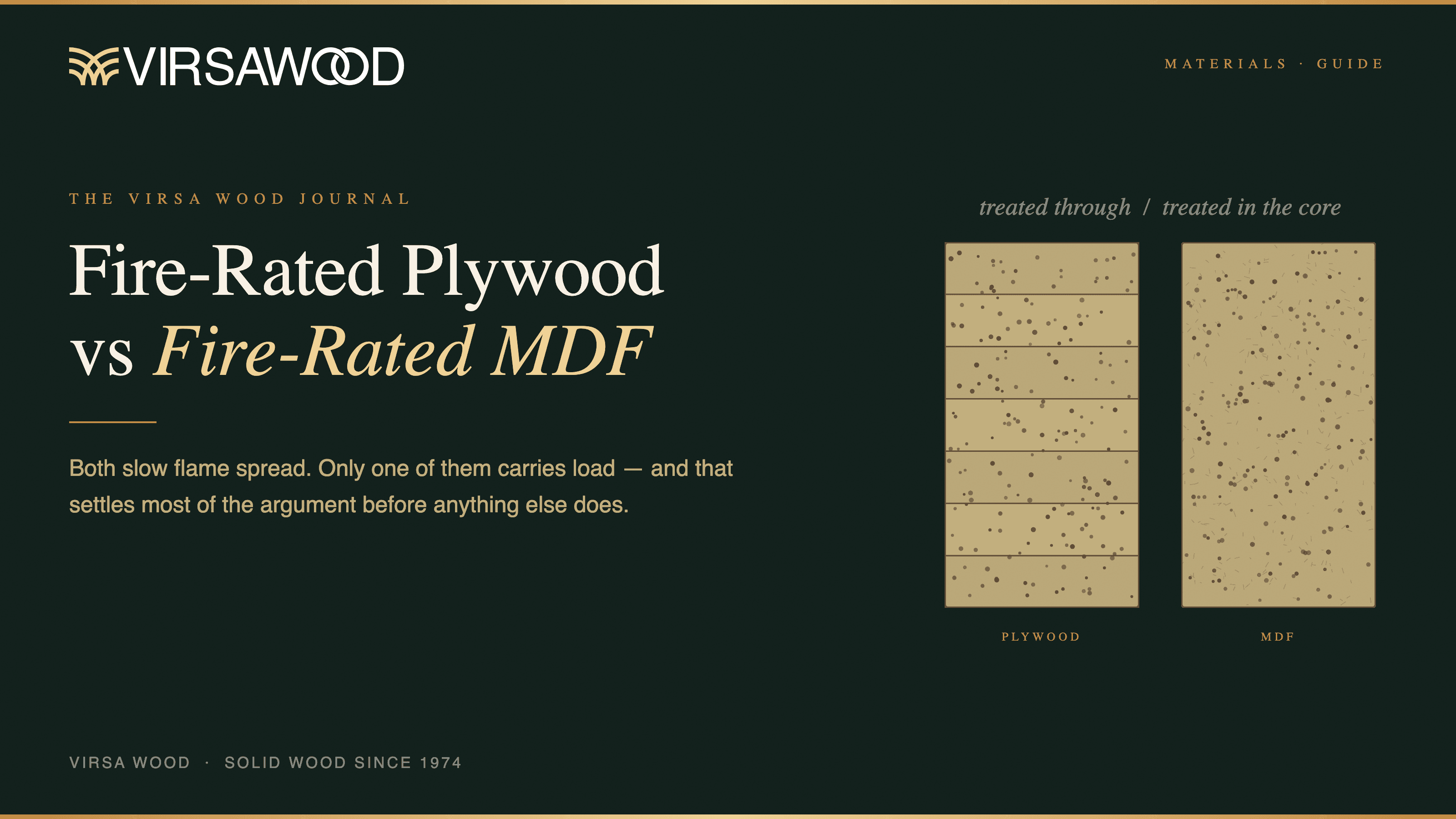
Both slow flame spread. Only one of them carries load. That single fact settles most of the argument before anything else gets a say.
Fire-rated plywood and fire-rated MDF get listed next to each other on spec sheets, and the naming suggests two versions of the same product. They are not. They start from different materials, they are treated at different points in manufacture, and they fail in different ways. Order the wrong one and the cost is not the panel — it is the week you lose taking it back out.
We are a furniture and interiors workshop, not a panel supplier. But fitted work is where these boards end up, and the question comes up on site often enough to be worth answering properly.
What Fire-Rated Plywood Is
Fire-rated plywood is ordinary plywood, usually structural grade, that has been pressure-treated with fire retardant chemicals. The treatment is forced into the wood fibre under pressure, so it is distributed through the panel rather than sitting on the face. That is what the FRT (fire retardant treated) or FRTW label refers to.
It comes in structural grades for sheathing and finish grades for interior panels. It holds screws properly, cuts with ordinary tooling, and looks broadly like untreated plywood. Expect some yellowing from the treatment chemicals — usually slight on finish grades, more noticeable on structural ones.
Two practical notes. The treatment salts are hard on cutting edges, so budget for blade wear. And take the dust seriously: extraction and a proper mask, not a paper one. Everything in our guide to cutting plywood without splintering still applies to a treated panel.
What the Rating Actually Measures
A surface fire rating is not a measure of how long a panel holds back a fire. It measures how fast flame travels across the surface, and how much smoke that produces. Fire resistance — the hour rating on a wall or a door — is a different test entirely, and the two get confused constantly.
Which scale you are being quoted depends on where the project is specified. In the United States, ASTM E84 (the Steiner tunnel test) puts a material in Class A when its flame spread index is 25 or below and its smoke developed index is 450 or below. Untreated plywood does not come close; it typically lands in Class C. In Europe and the many markets that follow European standards, the system is EN 13501-1, which grades from A1 down to F, with separate suffixes for smoke (s1–s3) and flaming droplets (d0–d2). The two systems are not interchangeable and a class letter from one means nothing in the other.
Both fire-rated plywood and fire-rated MDF can be manufactured to Class A under ASTM E84. So the rating rarely decides between them. Everything else does.
What we will not do is tell you which class your project needs. That comes from your local building code and, on anything commercial, from the fire consultant on the job. A panel described as "fire-rated" with no standard named, no class and no test certificate attached is a description, not a specification. Ask for the certificate before you ask for the price.
What Fire-Rated MDF Is
Fire-rated MDF starts as ordinary MDF — a wood fibre composite — with fire retardant either blended into the fibre before pressing or applied to the surface afterwards. It is an interior material and it is not structural. Neither of those is negotiable.
What makes it worth using is that it behaves like normal MDF. The face is smooth and uniform, it takes paint without grain telegraphing through, and it machines cleanly for profiles and rebates. The edges are more porous than plywood and have to be sealed before painting, particularly anywhere humidity moves. It is also heavier than plywood at the same thickness, which matters more than people expect once you are lifting a run of wall panels into place.
Everything in our guide to priming and painting MDF applies here. The edge sealing matters more, not less.
Treated Through, or Treated on the Surface
This is the distinction that costs people money, and the labelling rarely makes it obvious.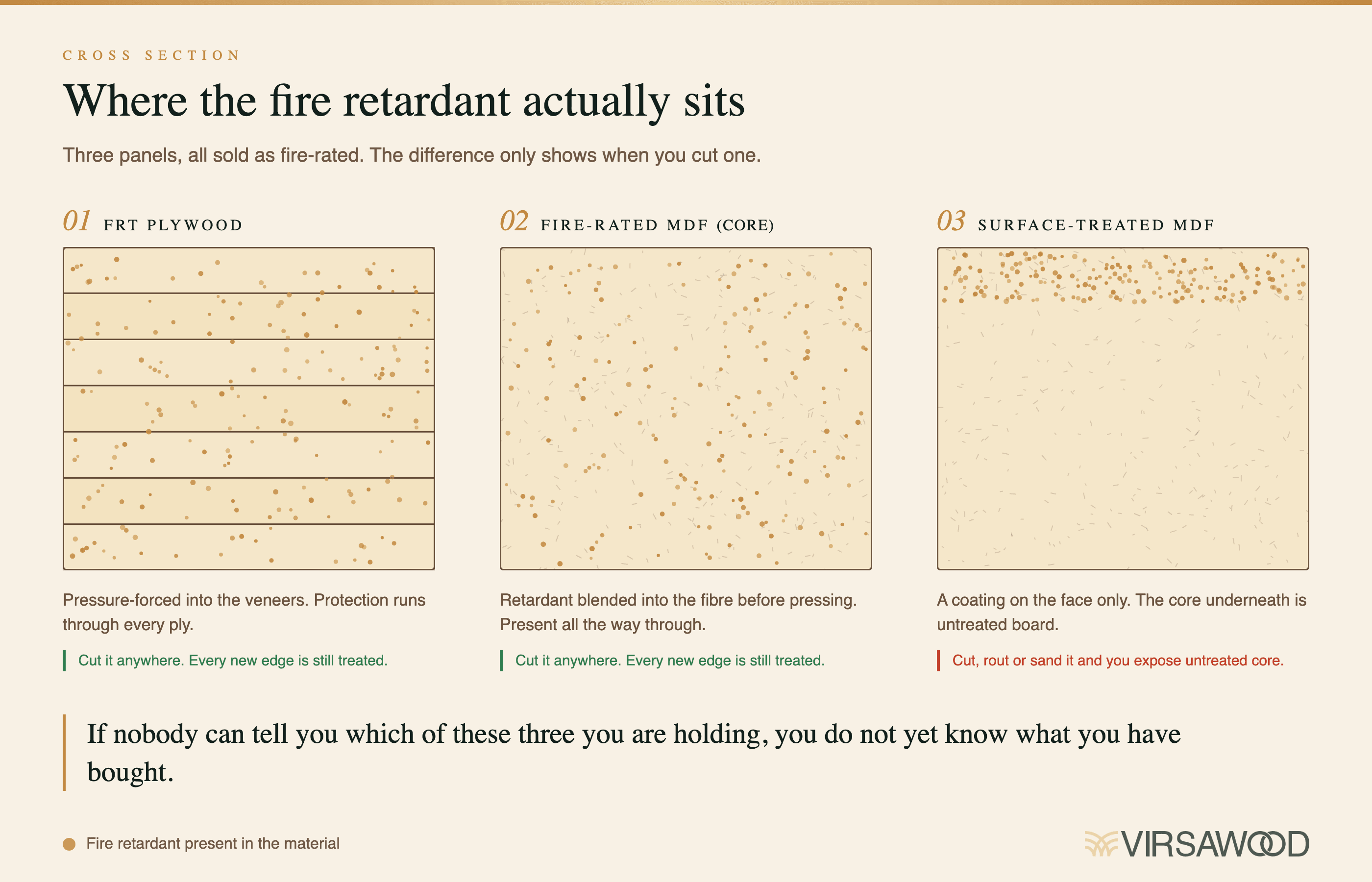
Pressure-treated plywood and core-additive MDF carry the retardant through the whole panel. Cut them, rout them, sand them, and every fresh surface is still treated material.
Surface-treated MDF does not work that way. The protection is a coating on the face. Rip the sheet down and the new edge is untreated board. Sand back too far preparing for paint and you are into untreated board. On a job where panels get scribed to a wall, notched around services and trimmed on site — which is every fitted job — that is not a small detail.
Ask which one you are being sold, and get the answer in writing. If it is vague, assume surface treatment and price accordingly.
The Differences That Matter
Factor Fire-Rated Plywood Fire-Rated MDF
Base material Wood veneer layers Wood fibre composite
Structural use Yes No
Where the retardant sits Pressure-forced through the panel Blended through the core, or coated on the face
Weight Lighter Heavier
Surface quality Depends on grade Smooth and uniform
Moisture tolerance Better Poor; edges vulnerable
Screw holding Excellent Moderate
Fire rating Class A achievable (ASTM E84) Class A achievable (ASTM E84)
Best for Structural work, loaded interior fixing Painted millwork, cabinetry, panelling
Three of those rows do the real work.
Load-bearing decides it outright. FRT plywood carries load. Fire-rated MDF does not — at any thickness, with any rating, in any circumstance. If the panel is holding something up, the conversation is over before it starts.
Surface quality decides the finish work. Fire-rated MDF's face needs almost no preparation before paint. FRT plywood's depends entirely on grade, and even a good face has grain that will read through a sheen. For painted cabinetry and millwork, MDF starts well ahead.
Moisture decides the room. FRT plywood tolerates humidity swings that will destroy MDF. MDF edges drink water and swell, and once swollen they do not recover — you replace the panel. Kitchens, bathrooms, anywhere with poor ventilation or a real seasonal humidity shift: plywood, or a sealing regime nobody on site is allowed to skip.
When to Use Fire-Rated Plywood
Anything Structural
Roof and wall sheathing, floor decking, and any panel that is part of how the building stands up. Fire-rated MDF is not a candidate here, so there is no comparison to make.
Interior Work That Has to Hold Something
Wall panelling that carries fixings, built-in millwork where hinges and drawer runners load the carcass, shelving that will genuinely be loaded rather than styled. FRT plywood holds a screw far better than MDF, and it keeps holding it after the third time somebody takes the door off to paint behind it.
Anywhere Moisture Is Plausible
Not only wet rooms. Any space where humidity swings seasonally, or where a leak is a realistic event rather than a theoretical one.
Work That Will Be Hidden
When the panel disappears behind a finish surface and appearance is irrelevant, plywood's advantages cost you nothing.
When to Use Fire-Rated MDF
Painted Millwork and Cabinetry
Cabinet boxes, shelving and built-ins in commercial interiors where a rated material and a flawless painted finish are both on the list. Schools, hospitals, hotels and office fit-outs use it for exactly this. If grain reading through paint is unacceptable and nothing is carrying load, MDF is the better material and it is not close.
Wall Panelling and Decorative Panels
Corridors, retail interiors, hospitality. Feature walls and architectural panels in a controlled interior environment. Consistency of face is what makes a large installation finish evenly — with plywood you are matching panels to each other, with MDF every sheet is already the same.
Can You Substitute One for the Other?
MDF in place of plywood works only where nothing is structural, nothing is loaded and nothing gets damp. Check the specification first. Where a spec names a material it usually names it for a reason, and on a fire-rated job that reason may be a certificate somebody has already signed their name to.
Plywood in place of MDF is usually possible for interior finish work, at a cost in labour. A good FRT panel with an A-grade face can be brought to a respectable painted finish, but it needs filling, sealing and considerably more sanding, and the grain may still show under a sheen. The substitution is technically fine and financially worse than it looks on the quote.
The Short Version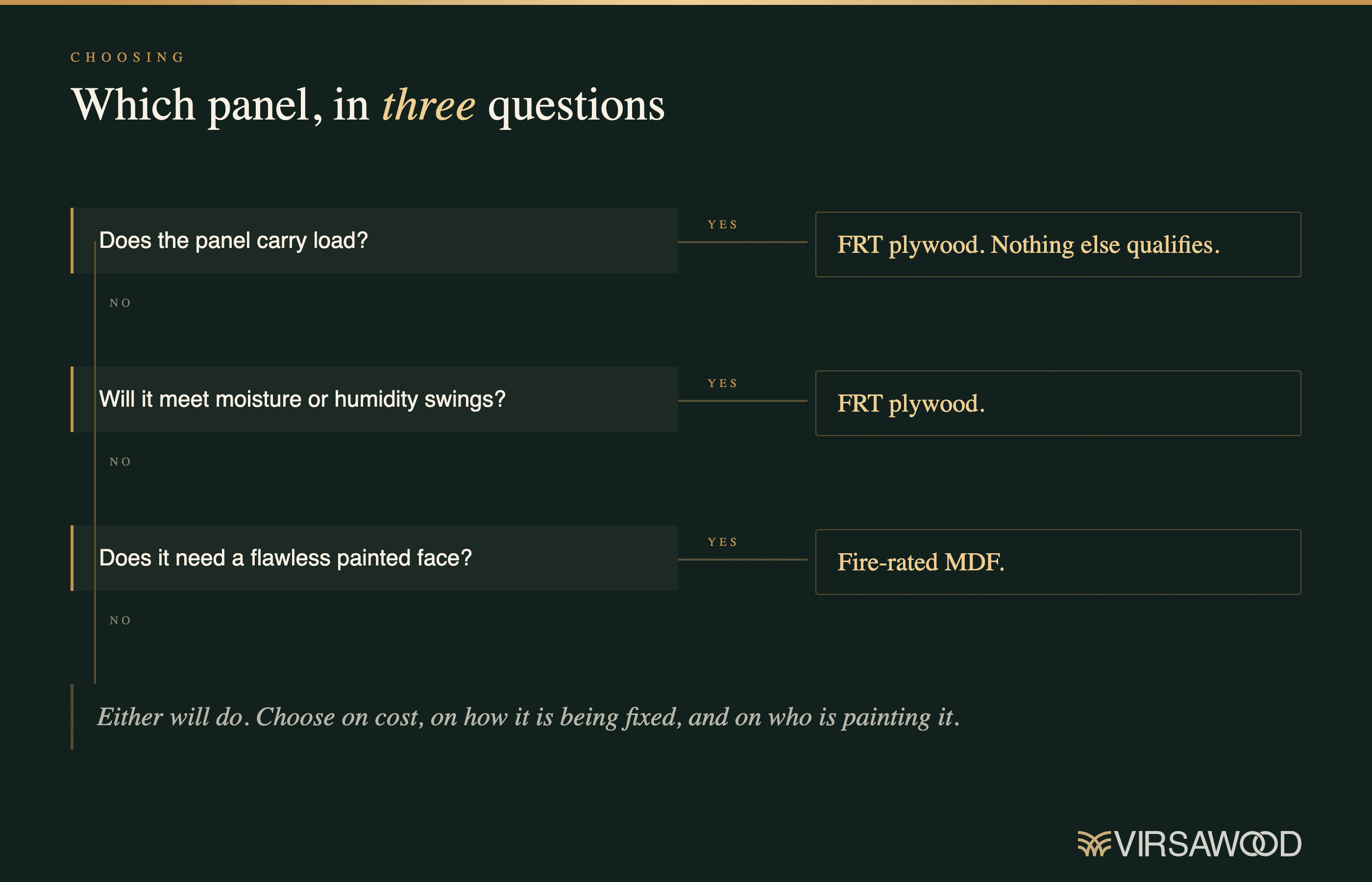
If it carries load, fire-rated plywood. If it gets damp, fire-rated plywood. If it is dry, unloaded and being painted, fire-rated MDF. If none of those apply, either will do and you should choose on cost and on how it is being fixed.
Then confirm two things before anything is ordered: which standard and class the project is specified to, and whether the retardant runs through the panel or sits on the face. Those two answers will matter more than which of the two materials you picked.
Where We Come Into This
Virsa Wood has been making solid wood furniture and interiors in Pakistan since 1974. We build fitted work — wardrobes, kitchens, panelling and ceilings — and on jobs where the specification calls for fire-rated board, we work to what the project's consultant has specified rather than deciding it ourselves. We do not sell panels, and this guide is not a sales page for them.
If you are planning fitted work and want to talk it through, call or WhatsApp +92 311 5254868, or see more at virsawood.com. We work across Lahore and Islamabad.
Frequently Asked Questions
What is the difference between fire-rated plywood and fire-rated MDF?
Both can reach Class A under ASTM E84, but they serve different applications. Fire-rated plywood is a structural material treated throughout with fire retardant under pressure. Fire-rated MDF is a non-structural interior product with retardant in the core or on the surface. One carries load and one does not, and that is what drives the choice.
Is fire-rated plywood the same as pressure-treated plywood?
No, and confusing them is a real mistake. Pressure-treated plywood is treated to resist rot, moisture and insects, usually for exterior or ground-contact use. Fire retardant treated plywood uses a different chemistry for a different purpose: slowing flame spread. Both happen to be applied under pressure, which is where the confusion comes from. They are not interchangeable in either direction.
Can fire-rated MDF be used in structural applications?
No. Fire-rated MDF cannot carry load regardless of its fire rating — the rating describes surface burning behaviour, not strength. Structural applications need FRT plywood or another load-bearing material. Fire-rated MDF is for interior finish work only.
Does cutting fire-rated board destroy its rating?
It depends entirely on how the panel was treated. If the retardant was pressure-forced through the plywood or blended into the MDF core, cutting exposes more treated material and the rating holds. If it was a surface coating, every cut edge and every over-sanded face is untreated board. This is the single most important question to ask about any panel sold as fire-rated, and it is the one least often answered on the label.
Enjoyed this?
Follow Virsa Wood on Google
Mark us as a preferred source and our stories on wood, craft and interiors will show up more often in your Google Search results.
Add as a preferred source