Furniture Design Trends 2026: 6 Shifts in Solid Wood
Six things changed in how solid wood is being asked for this year. Here is what is actually reaching the bench.
Most trend lists are about shape. This one is mostly about material.
We build furniture and fitted interiors, which means we tend to meet a trend as a request rather than as an article. A client describes what they want, and somewhere in the description is something that was not in last year's descriptions. Six of those have come up often enough in 2026 to be worth writing down.
- Grain Is Becoming the Focal Point
The wood itself is being treated as the artwork.
Boards with bold cathedral figure, flowing pattern and real character are being chosen deliberately, so a piece can carry visual interest without carving, inlay or applied detail. Large dining tables, desks, low tables and open shelving are the obvious beneficiaries. An uninterrupted run of grain across a two-metre top does more work than any amount of ornament.
This puts the pressure somewhere unfamiliar: on selection. A piece designed around its figure only works if the figure is worth looking at, which means the board has to be chosen before anything is cut, and the offcuts have to be accepted as part of the cost. It also means the surface has to be genuinely continuous.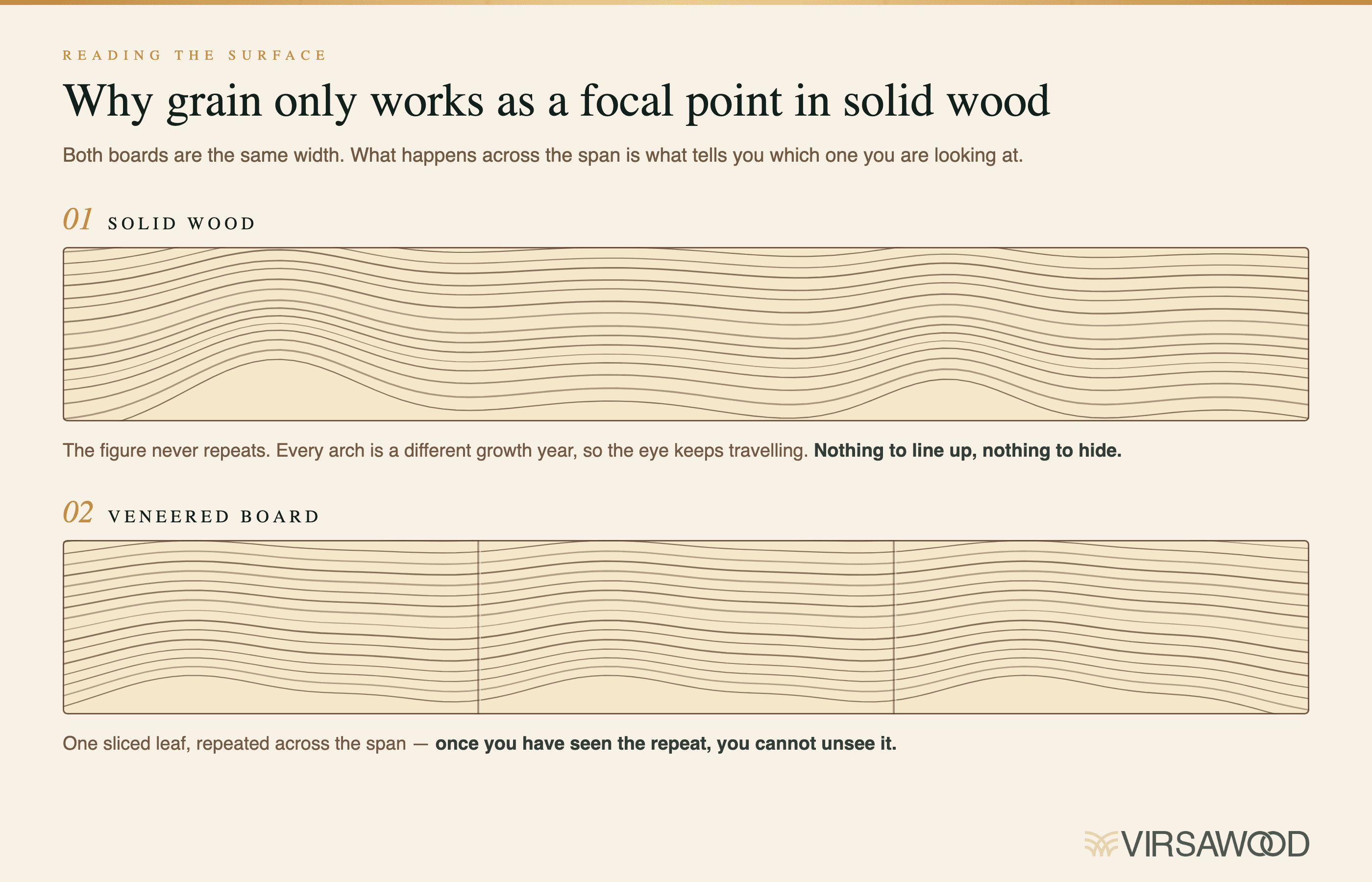
That is the part worth understanding before you commission anything. Solid timber gives you one surface with no repeat in it. A veneered panel gives you a sliced leaf laid down again and again, and at some width the eye finds the seam. Both have their place. Only one of them can be the focal point.
Related: Wooden furniture
- Curves Are Replacing Hard Corners
Soft edges are turning up everywhere. Chair backs, table corners, the vertical edges of a wardrobe run, the returns on a kitchen island.
The reasoning is straightforward. Modern rooms are full of straight lines, and a radius somewhere in the furniture stops the whole space reading like a drawing. It also makes a room feel less careful, which people seem to want more than they used to.
Wood suits this because there is more than one way to get there. A radius can be machined from solid, built up in laminations, or shaped by hand. What matters is that these are not interchangeable. They differ in cost, in how much material ends up as waste, and in how the piece behaves in five years. If you are commissioning something curved, ask how the curve is being made before you agree a price.
Related: Custom kitchens · Fitted wardrobes
3. Deeper Tones Are Coming Back
After a long run of pale, Scandinavian-influenced interiors, darker wood is returning.
Deep, chocolate-toned timber is doing the work it used to do in dining rooms, studies and built-in units. Alongside it, designers are reaching the same place with darker finishes over lighter timber: dramatic tone, grain still readable underneath. That second part is the whole trick. A dark finish that fills and flattens the surface is just paint with extra steps.
Dark wood also needs company. It sits best against pale walls, textured fabric, stone and warm metal. Put it in a dark room with dark textiles and you lose the grain you paid for.
Related: Wood panelling
- Custom Is Replacing Mass Production
Mass-produced furniture is built to a size that suits a warehouse. People are increasingly not accepting that.
A dining table sized to the actual room. Shelving that finishes at the actual ceiling. A wardrobe that uses the awkward 40cm nobody knows what to do with. None of this is new — it is simply what furniture was before it was flat-packed — but it is being asked for again, and that changes what the material has to be.
It also makes honesty about material more important, not less. We are not purists about it. Sheet material belongs in carcass backs, drawer bottoms and jigs, where stability matters more than figure. It just should not be sold as something it isn't. We have written separately about cutting plywood cleanly and painting MDF properly, because both are genuinely useful materials and both get misrepresented.
Related: Wooden furniture
- Biophilic Design Has Moved Past Houseplants
Biophilic design started as greenery. It has become material.
The idea now is that a room should carry natural texture in its surfaces, not only in its objects. Timber ceilings, exposed beams, panelled walls, open shelving, cabinetry with visible grain. A plant in the corner is decoration. A wooden ceiling changes how the room sounds and how the light moves through it.
This is the trend with the widest gap between effort and effect. Panelling one wall, or running a timber detail across a ceiling, costs far less than refurnishing a room and usually does more.
Related: Wood panelling · False ceilings
- Furniture Has to Do More Than One Job
Living rooms became offices. Spare bedrooms became gyms. Nobody has fully changed them back.
So the furniture is expected to keep up. Tables that extend, shelving that reconfigures, desks that stop looking like desks at six o'clock, storage that hides the fact a room has two lives. Built-in work carries most of this, because a fitted piece can be designed around two uses in a way a bought one cannot.
If you are working with a room you already have, the cheapest version of this is usually a conversion rather than a new build. We wrote a full guide on turning a closet into a built-in cabinet.
Related: Fitted wardrobes
The Thread Running Through All Six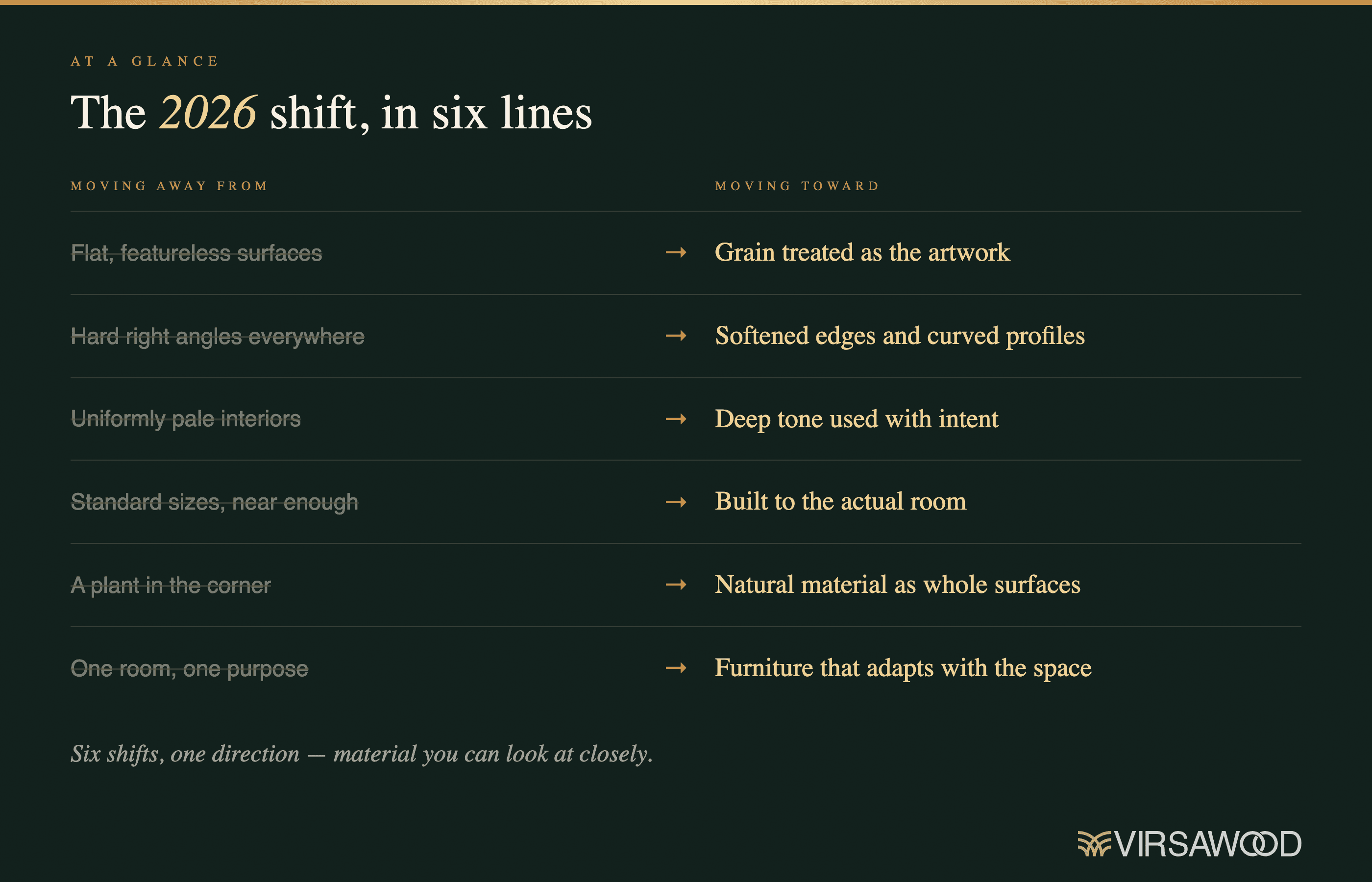
Every one of these is a move toward material that survives being looked at closely.
Grain as a focal point only works if the grain is real. Curves only hold up if the method behind them is sound. Deep tone only reads as wood if the finish lets the grain through. Built-to-fit only matters if the thing it is built from lasts long enough to justify the fitting. The common demand underneath all six is inspection.
That suits us, because it is how we have had to work anyway. Virsa Wood has been making solid wood furniture and interiors in Pakistan since 1974. Fifty-odd years is long enough to watch several trends arrive, leave, and come back wearing a different name. The pieces that outlast all of it are the ones that were made properly to begin with.
Common questions
Which of these trends will date fastest?
Tone. Colour preference moves faster than form or material, and today's deep finishes will feel dated before a well-proportioned table does. If you want the trend without being caught by it, put the fashionable tone on something you can refinish or replace, and keep the expensive, permanent pieces nearer the natural colour of the wood.
Is solid wood always the right choice?
No. Solid timber moves with humidity, so a wide unbroken panel in a wardrobe back or a drawer bottom is a liability rather than a feature. Engineered board is the better engineering answer in those places. The distinction that matters is whether the material was chosen for the job or chosen for the invoice.
How can I tell whether furniture is solid wood before I buy it?
Look at the edges and the underside. On solid timber the grain on the face carries around onto the edge and matches. On a veneered panel it stops, because the edge is a separate strip. Then look across the width for a repeat — a pattern that resets at a regular interval is a sheet, not a board.
Building something this year?
We make furniture, fitted wardrobes, kitchens, panelling and ceilings to order, and we work across Lahore and Islamabad. If you have a room, a rough idea and no drawings, that is a normal place to start. Call or WhatsApp +92 311 5254868, or see more at virsawood.com.
Enjoyed this?
Follow Virsa Wood on Google
Mark us as a preferred source and our stories on wood, craft and interiors will show up more often in your Google Search results.
Add as a preferred source